





FAQ
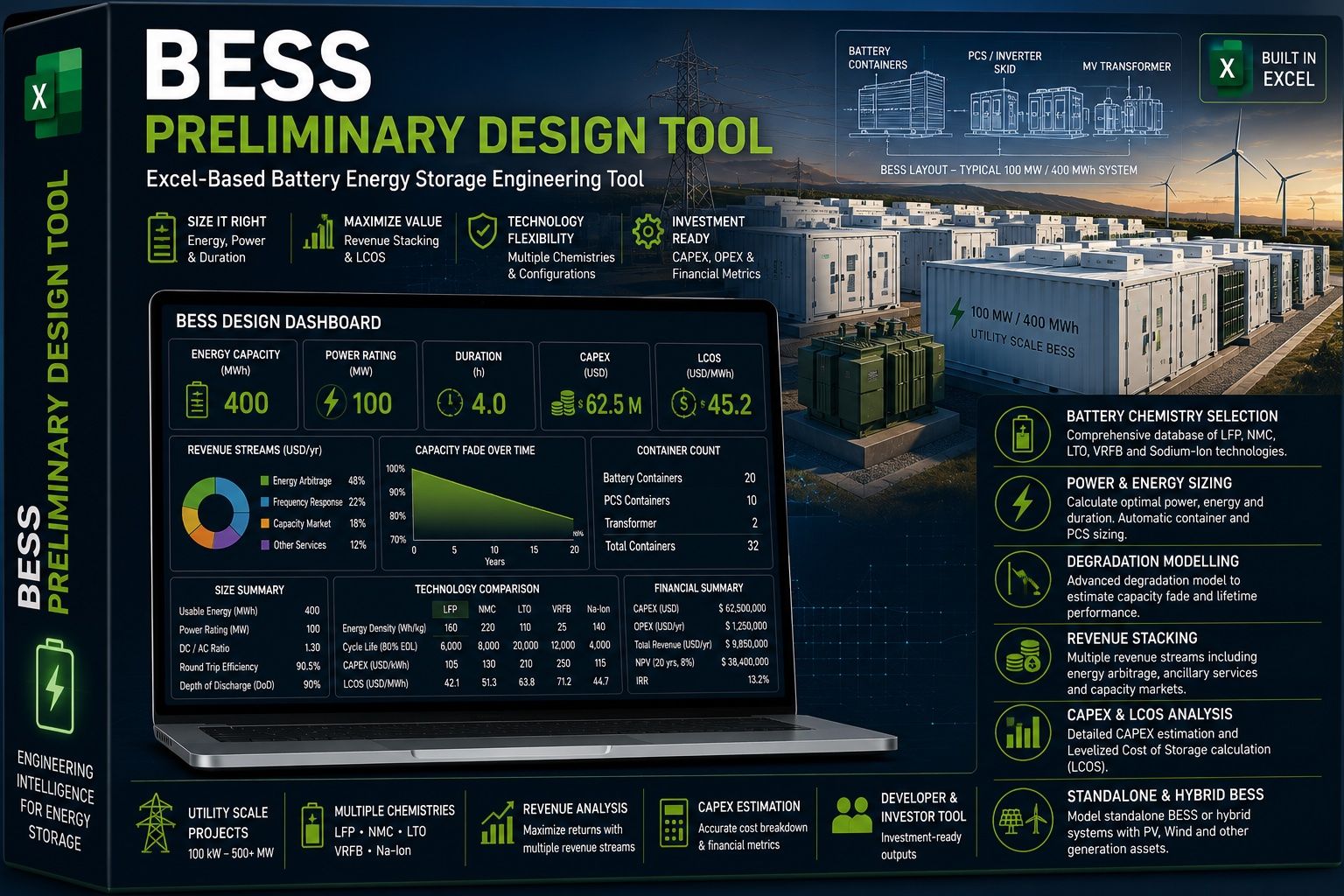
The BESS Preliminary Design Tool solves this problem by giving engineers, developers and technical advisors a structured Excel calculator for early-stage battery storage sizing.
It helps you move from a generic MW/MWh concept to a more defensible pre-feasibility design.
-
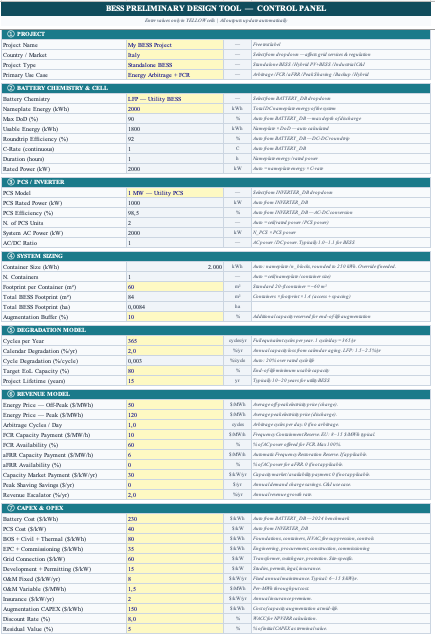
Select from 10 battery chemistries including LFP, NMC 622, NMC 811, NMC Long Duration, NCA, LTO, VRFB and Na-Ion
-
Auto-load key technical parameters: cycle life, depth of discharge, roundtrip efficiency, C-rate and battery cost
-
Select from 8 PCS reference units from 250 kW to 4 MW
-
Calculate PCS units, AC power, AC/DC ratio and exportable system power
-
Auto-size BESS containers using adaptive container sizing in 250 kWh multiples
-
Estimate total BESS footprint with access and spacing factor
-
Model 25-year degradation using combined calendar and cycling degradation
-
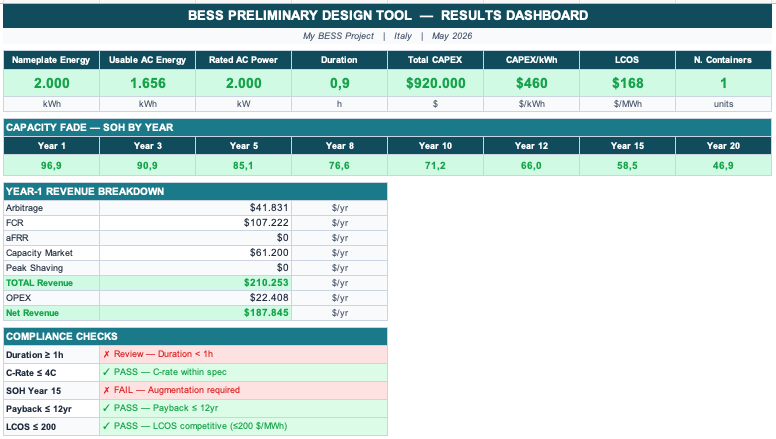
Track annual SOH, usable energy and end-of-life capacity
-
Identify augmentation needs when SOH falls below the target threshold
-
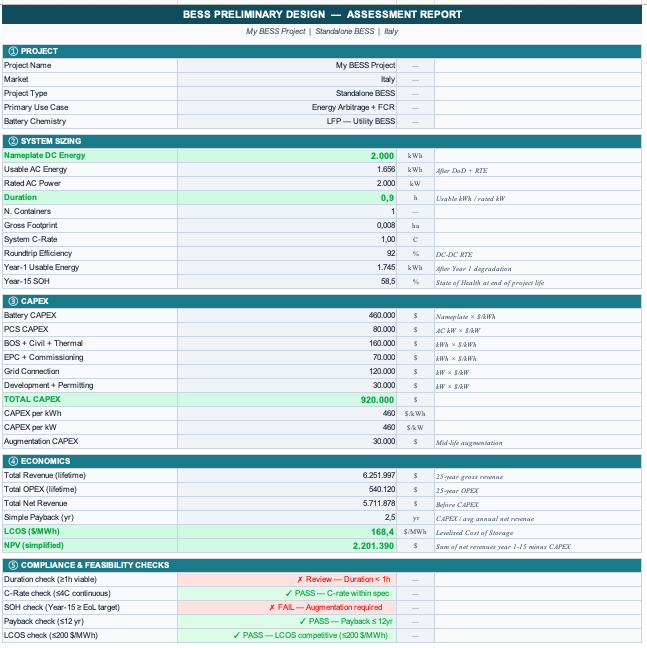
Estimate CAPEX breakdown: battery, PCS, BOS, civil, thermal, EPC, grid connection and development
-
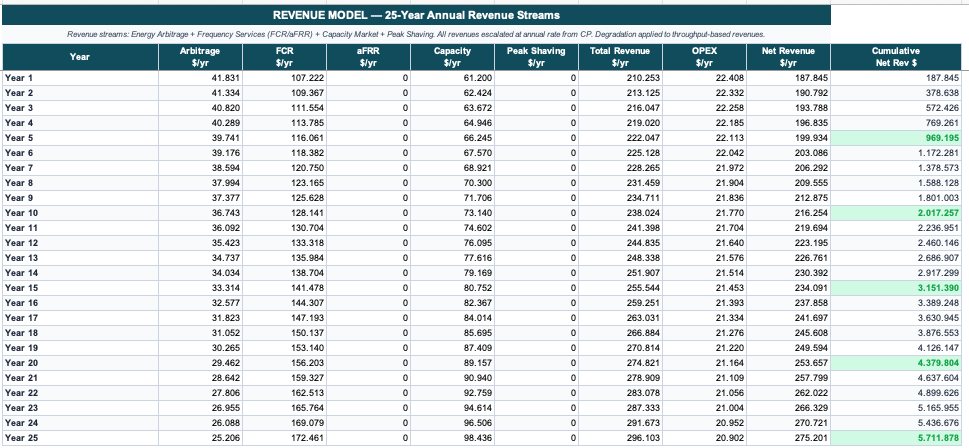
Model 5 revenue streams: arbitrage, FCR, aFRR, capacity market and peak shaving
-
Calculate LCOS on lifetime throughput
-
Review simplified NPV, simple payback and compliance checks
-
Use dashboard KPI cards, SOH milestones, Year-1 revenue breakdown and compliance summary
This tool is especially useful for:
-
BESS developers screening project configurations
-
Storage engineers testing MW/MWh sizing options
-
EPC and technical teams preparing early design assumptions
-
Grid services teams comparing use cases such as arbitrage, FCR and aFRR
-
Technical advisors reviewing battery sizing logic
-
Investors and project managers who need a preliminary technical check before full due diligence
-
Analysts preparing inputs before using a complete BESS financial model
Excel tool · editable assumptions · multilingual guide included · pre-feasibility ready · instant download.
100% money-back guarantee: if the tool does not meet your expectations, you get a full refund.
What is the BESS Preliminary Design Tool?
It is an Excel engineering calculator for early-stage sizing and pre-feasibility analysis of utility-scale battery energy storage systems.
Who is this tool for?
It is designed for BESS developers, storage engineers, EPC teams, technical advisors, project managers, consultants and analysts working on battery storage projects.
Which battery chemistries are included?
The tool includes LFP, NMC 622, NMC 811, NMC Long Duration, NCA, LTO, VRFB and Na-Ion options, with technical parameters such as cycle life, DoD, RTE, C-rate and cost.
Does the tool size the PCS?
Yes. It includes 8 PCS reference units and calculates the number of PCS units, system AC power and AC/DC ratio.
Does it calculate container sizing?
Yes. The tool includes automatic BESS container sizing based on the selected nameplate energy, using 250 kWh multiples.
Does the tool model degradation?
Yes. It models 25-year degradation using calendar and cycling degradation, tracks SOH and identifies augmentation needs.
Does it include revenue streams?
Yes. It includes five revenue streams: arbitrage, FCR, aFRR, capacity market and peak shaving.
Does it calculate LCOS?
Yes. The tool calculates LCOS based on lifetime throughput, including CAPEX, OPEX and augmentation CAPEX.
Is the NPV a full discounted project finance NPV?
No. The tool includes a simplified NPV based on cumulative net revenue minus CAPEX and augmentation. For investor-grade discounted cash flow analysis, use the BESS Ultimate Model.
Does this replace detailed engineering studies?
No. It is a pre-feasibility and screening tool. Final design should be verified with vendor data, certified degradation curves, grid code requirements, fire safety standards and detailed engineering studies.
Need the full investment case?
Use this tool to validate the preliminary BESS technical design. When you need full project economics, IRR, NPV, DSCR, debt schedule, revenue waterfall, country scenarios and 20-year financial modelling, move to the BESS Ultimate Model or the BESS Ultimate Model + Portfolio Manager.