

FAQ
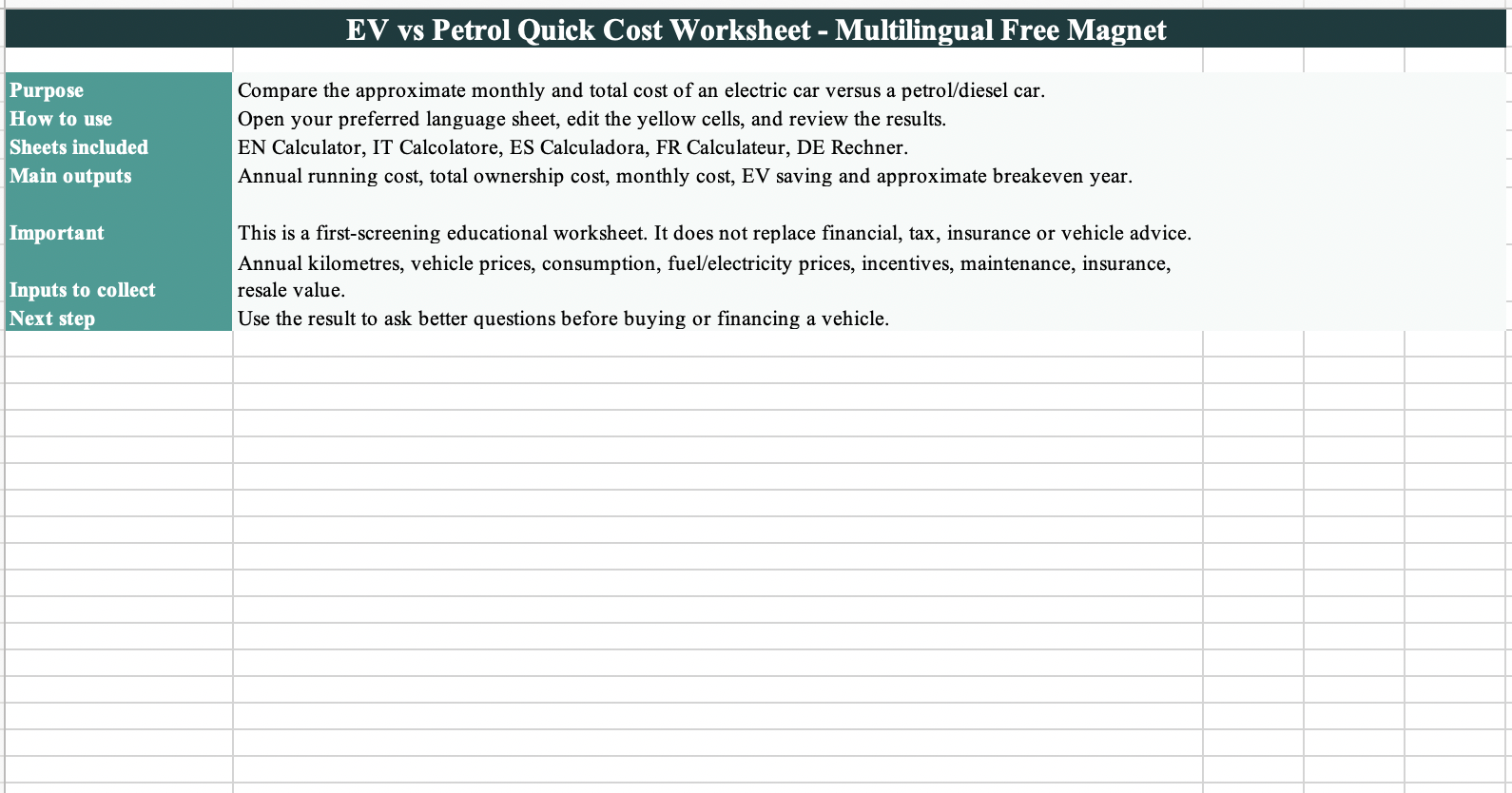
The EV vs Petrol Quick Cost Worksheet is a free multilingual Excel file designed for private consumers, families and non-experts who want to compare the real cost of an electric car versus a petrol or diesel car before buying, financing or switching vehicle.
No technical knowledge required.
No financial modelling required.
No complicated formulas to build.
Just open the Excel file, edit the yellow cells and compare the results.
This free Excel worksheet helps you understand:
-
whether an electric car may be cheaper or more expensive for your situation
-
how annual kilometres affect the comparison
-
how fuel price and electricity price change the result
-
how home charging and public charging affect EV cost
-
how incentives reduce the upfront cost
-
how maintenance and insurance affect yearly cost
-
how resale value changes the total cost of ownership
-
how charger installation affects the EV scenario
-
what the average monthly cost may look like
-
when the EV may approximately break even versus petrol or diesel
The free Excel worksheet includes:
-
Editable input sheets in five languages
-
Yellow input cells for easy use
-
Petrol/diesel car scenario
-
Electric car scenario
-
Annual fuel cost calculation
-
Annual EV charging cost calculation
-
Annual running cost calculation
-
Net upfront cost calculation
-
Total ownership cost over the selected period
-
Average monthly cost
-
EV saving versus petrol/diesel
-
Approximate breakeven year
-
Quick summary section
-
Plain-language guidance for non-experts
-
No payment required
-
Available in five languages: English, Italian, Spanish, French and German
What you can edit in the Excel file
The worksheet lets you change the main assumptions that drive the comparison.
Driving distance
Enter how many kilometres you drive each year.
This matters because the more you drive, the more fuel or electricity cost affects the result.
A person driving 5,000 km per year and a person driving 25,000 km per year may get very different answers.
Purchase price and incentives
Enter the purchase price of the petrol/diesel car and the electric car.
You can also enter incentives or grants.
This helps you compare the real net upfront cost, not just the sticker price.
Resale value
Enter the estimated value of each car at the end of the analysis period.
This is important because a car is not only what you pay today.
It is also what it may be worth later.
Fuel and electricity consumption
For the petrol or diesel car, enter fuel consumption in litres per 100 km.
For the electric car, enter electricity consumption in kWh per 100 km.
This helps compare real energy cost per kilometre.
Fuel price and charging cost
Enter the fuel price, home electricity price and public charging price.
For EVs, the worksheet also lets you enter the share of charging done at home.
This matters because home charging is often very different from public charging.
Maintenance, insurance and taxes
Enter annual maintenance, insurance, taxes and other recurring costs.
These costs can change the real monthly cost and should not be ignored.
Charger installation
If you need to install a home charger, you can include that one-off cost in the EV scenario.
This helps avoid underestimating the real first-year or total cost of switching to electric.
The Excel worksheet calculates:
1. Annual fuel or electricity cost
The worksheet estimates how much you may spend every year on petrol/diesel or EV charging.
2. Annual running cost
It combines energy cost, maintenance, insurance, taxes and other annual costs.
3. Net upfront cost
It considers purchase price, incentives and charger installation where relevant.
4. Total ownership cost
It estimates the total cost over the selected period, including running costs and resale value.
5. Average monthly cost
It converts the total ownership cost into an approximate monthly cost.
This makes the comparison easier to understand for normal household budgeting.
6. EV saving versus petrol/diesel
It shows whether the EV is cheaper or more expensive than the petrol/diesel car in the selected scenario.
7. Approximate breakeven year
It estimates when the EV may recover its higher upfront cost through lower running costs, where applicable.
Use this free Excel worksheet when you want to:
-
compare an electric car with a petrol or diesel car
-
understand the real monthly cost before buying
-
check whether EV savings apply to your situation
-
compare fuel cost with charging cost
-
understand the impact of home charging
-
include incentives and resale value
-
include maintenance, insurance and taxes
-
avoid relying only on purchase price
-
prepare before visiting a dealership
-
make a better car-buying decision without technical jargon
Want to go deeper?
This worksheet gives you a first comparison.
The next step is to understand your own mobility and home energy situation:
-
How many kilometres do you really drive?
-
Can you charge at home?
-
How much would public charging cost you?
-
Would solar panels reduce your EV charging cost?
-
Are you buying cash or financing the car?
-
How long will you keep it?
-
How much resale value do you expect?