

FAQ
The Debt Sizing Calculator helps you solve this first financing question: how much debt can a renewable energy project support while respecting a minimum DSCR covenant?
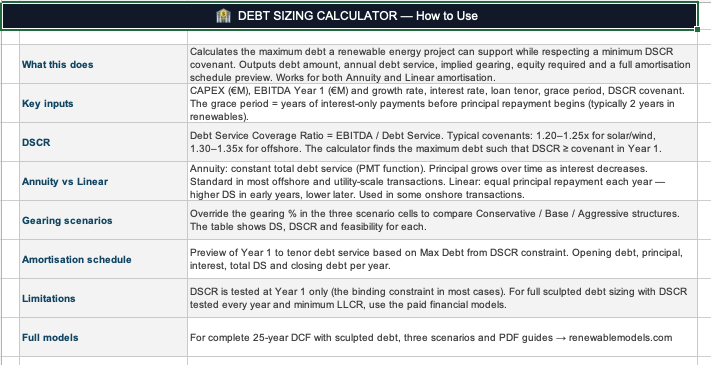
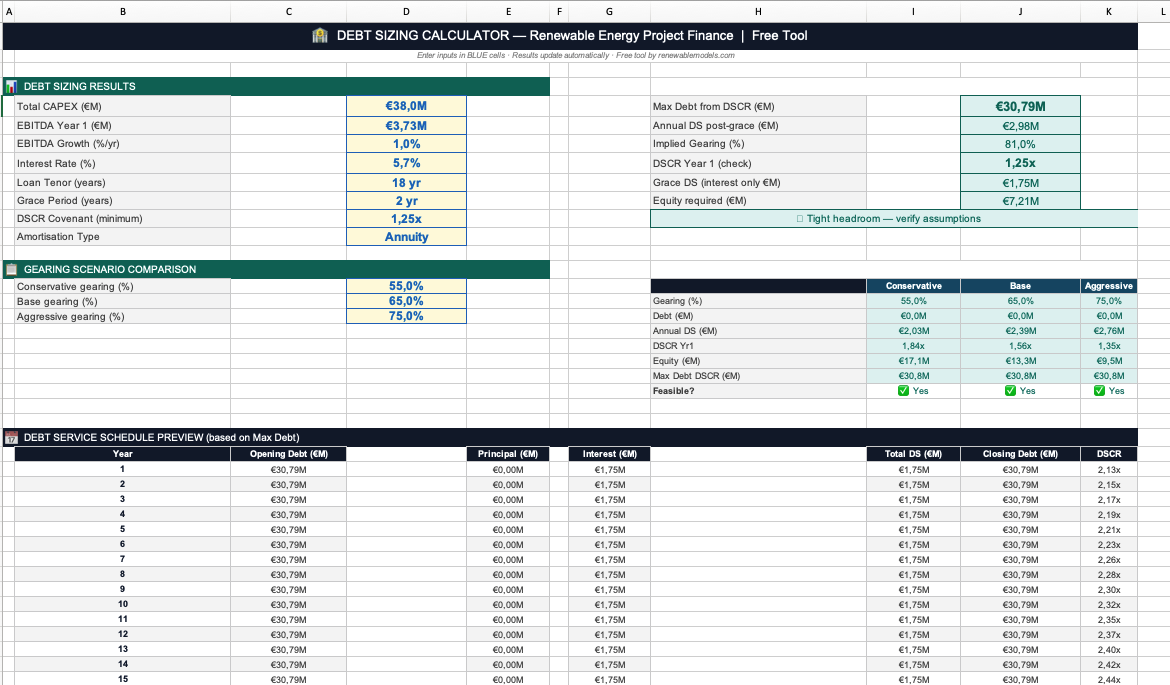
You enter the key inputs — CAPEX, EBITDA Year 1, EBITDA growth, interest rate, loan tenor, grace period, DSCR covenant and amortisation type — and the tool estimates maximum debt, annual debt service, implied gearing, equity required and a debt service schedule preview.
This is not a full project finance model.
It is the first screening layer before you build the full DCF.
Use it to check whether your assumed debt level is realistic before spending time on a complete financial model, investment memo or lender discussion.
The free tool includes:
-
Maximum debt calculation based on DSCR covenant
-
Annual debt service after grace period
-
Implied gearing percentage
-
Equity required calculation
-
DSCR Year 1 check
-
Grace period debt service based on interest-only payments
-
Warning message if DSCR headroom is tight or below covenant
-
Annuity and linear amortisation options
-
Conservative, Base and Aggressive gearing scenario comparison
-
Feasibility check for each gearing scenario
-
Debt service schedule preview with opening debt, principal, interest, total debt service, closing debt and DSCR
-
Simple “How to Use” sheet explaining inputs, DSCR, amortisation and limitations
Use this free calculator when you need to:
-
Check how much debt a renewable energy project can support
-
Test whether a 55%, 65% or 75% gearing assumption is feasible
-
Estimate annual debt service before building a full project finance model
-
Understand the impact of interest rate, tenor, grace period and DSCR covenant
-
Prepare a quick debt capacity estimate for an investment memo or internal review
-
Avoid building a full business case around a debt assumption that lenders may not accept
Free Excel calculator · instant download · editable assumptions · no payment required.
What is a debt sizing calculator?
A debt sizing calculator estimates how much debt a project can support based on EBITDA, interest rate, loan tenor, grace period and minimum DSCR covenant.
What is DSCR?
DSCR means Debt Service Coverage Ratio. It is calculated as EBITDA divided by annual debt service. Lenders use it to check whether the project generates enough cash flow to repay debt.
What inputs do I need?
You need total CAPEX, EBITDA Year 1, EBITDA growth rate, interest rate, loan tenor, grace period, DSCR covenant and amortisation type.
What outputs does the calculator provide?
The tool calculates maximum debt from DSCR, annual debt service, implied gearing, equity required, DSCR Year 1, grace-period interest and a debt service schedule preview.
Can I compare different gearing levels?
Yes. The calculator includes Conservative, Base and Aggressive gearing scenarios, so you can compare debt amount, annual debt service, DSCR and feasibility.
Does it support different amortisation types?
Yes. The tool supports annuity amortisation and linear amortisation.
Is this a full project finance model?
No. It is a free screening tool. It does not replace a full DCF model with revenue modelling, sculpted debt, LLCR, cash flow waterfall, tax treatment and sensitivities.
Does the calculator test DSCR every year?
The free calculator is designed for quick screening and focuses on the Year 1 DSCR constraint. For full annual DSCR testing and sculpted debt, use a complete project finance model.
Who is this tool for?
It is designed for developers, investors, analysts, consultants and students who need a quick debt capacity check for renewable energy projects.
Need the full investment case?
Use this free Debt Sizing Calculator to check debt capacity and DSCR quickly. When you need full 20–25 year cash flows, sculpted debt, IRR, NPV, LLCR, revenue waterfall, sensitivity analysis and project-level scenarios, move to the dedicated premium financial models.